









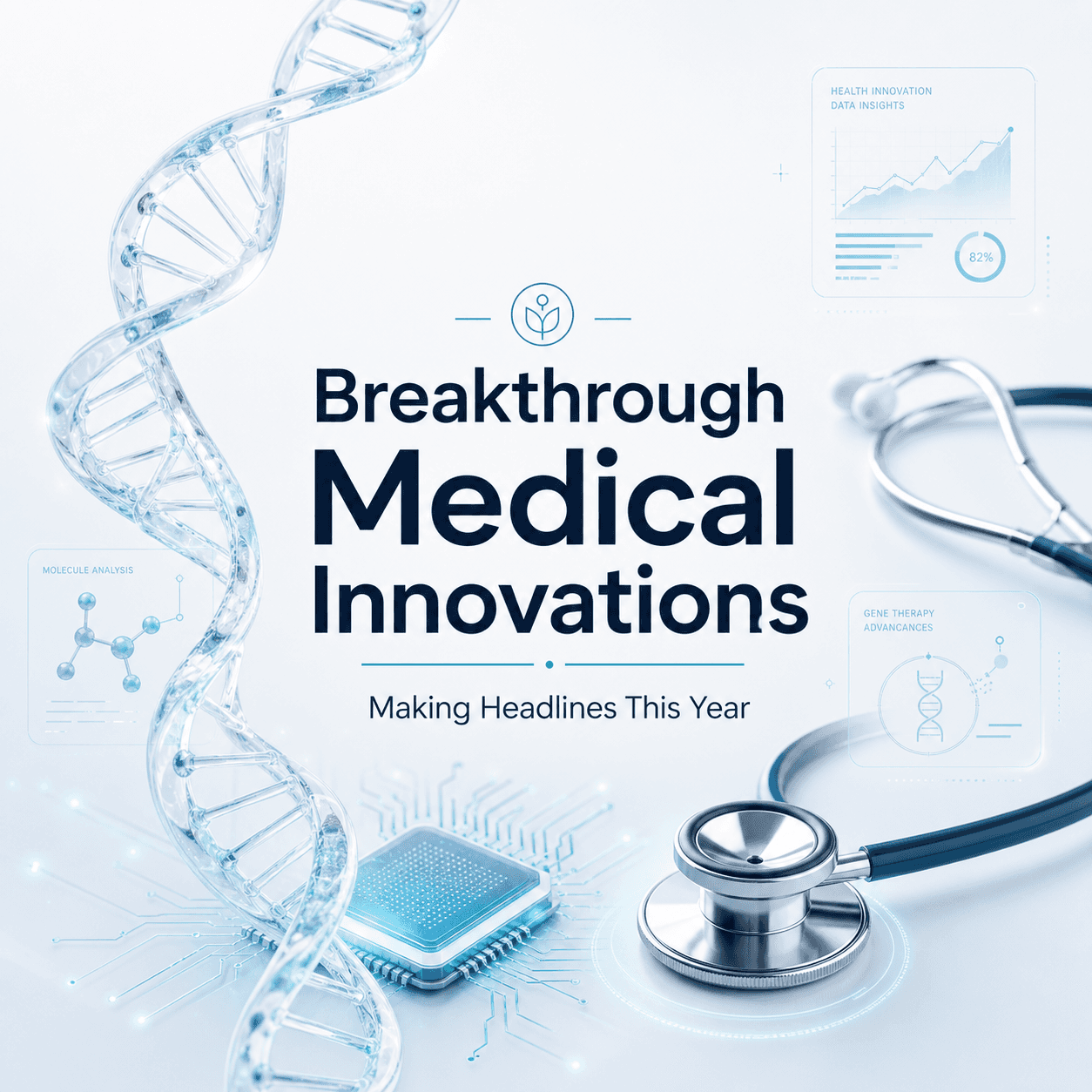
Some years in medicine feel like slow, careful progress. A new drug here. A slightly better scanner there. Good stuff, but incremental.
And then you get a year like this one.
It’s not that every headline is a miracle. It’s more that the “impossible” category keeps shrinking. Things that used to be stuck in academic papers or early stage trials are showing up in real hospitals, in real workflows, with real patients. Sometimes messy. Sometimes controversial. But moving.
Below are the medical innovations making the most noise right now. Not hype. Not sci fi. Actual breakthroughs people are building, testing, shipping, arguing about, and in a few cases… already using.
1. CRISPR Based Therapies That Are Actually Getting to Patients
For years, CRISPR lived in the land of “this could change everything.” Which is a phrase that usually means, “come back in ten years.”
But gene editing is now crossing into something more concrete: approved therapies, late stage pipelines, and clinics learning how to deliver them.
This year’s biggest shift is not just that CRISPR can edit genes. We already knew that. It’s that delivery, safety, and manufacturing are getting good enough to scale beyond a handful of experimental cases.
The main storylines:
- One time treatments for inherited disease. Instead of lifelong management, you treat the root cause once, then monitor.
- Better targeting. Researchers keep improving how they avoid off target edits and reduce unintended changes.
- A broader menu of editing tools. CRISPR is no longer just “cut the DNA and hope the cell repairs it the right way.” You now have base editors, prime editing, and other approaches that can be more precise.
The catch, and it’s a big one. These treatments can be extremely expensive and the logistics are not trivial. You need specialized centers, careful patient selection, and long term follow up. But the direction is obvious. We’re watching gene editing turn into a real clinical category.
2. The Rise of Personalized Cancer Vaccines
Cancer vaccines have had a rough history. Lots of excitement, lots of disappointment. This year feels different.
The reason is personalization.
Instead of trying to create a one size fits all vaccine for “lung cancer” or “melanoma,” these new approaches analyze a patient’s specific tumor mutations, then design a vaccine that trains the immune system to recognize those exact targets.
That’s a huge conceptual shift.
What’s making headlines now:
- mRNA platforms applied to oncology. The same general tech family that proved itself during the pandemic is being adapted to cancer.
- Combination therapy results. Many of the most promising outcomes are not vaccine alone. They’re vaccine plus checkpoint inhibitors, which is where the immune response can become more durable.
- Faster manufacturing timelines. Still not instant, but faster than it used to be. Which matters because cancer does not wait politely.
You still have open questions. Which cancers respond best? How do you choose antigens? How do you make this affordable? But even with those questions, it’s hard not to notice the vibe shift. Personalized cancer vaccination is moving from “interesting idea” to “plausible standard tool.”
3. AI That Finds Disease Earlier, Quietly, in the Background
A lot of AI in medicine has been loud. Big promises, flashy demos, then awkward reality. This year, the more interesting trend is the opposite.
AI that works quietly.
Not replacing clinicians. Not doing dramatic “doctor in a box” stuff. Just scanning images, labs, vitals, and notes in the background and nudging people when something looks wrong.
The innovations making news:
- Imaging triage. AI models that flag suspicious findings on chest X rays, mammograms, CT scans, and brain imaging so radiologists can prioritize urgent cases.
- Early sepsis alerts. Not perfect, and hospitals are rightfully cautious, but systems are improving at identifying patterns before a patient crashes.
- Predicting deterioration on wards. Using continuous vitals and EHR data to identify patients who look stable but are trending toward trouble.
The biggest breakthrough here is not a single model. It’s implementation. Better integration into clinical workflows, better evaluation, more realistic claims, and more attention to false alarms and bias.
There’s still plenty of skepticism. There should be. But you can feel AI becoming less of a product and more of an infrastructure layer. Like electricity. You stop noticing it, until it’s gone.
4. Blood Tests for Early Cancer Detection Keep Getting Real
Liquid biopsies have been teased for years: detect cancer early with a blood draw, before symptoms, before a tumor is big enough to show up clearly on imaging.
This year, the headline isn’t “we can detect cancer.” It’s the steady progress on the hard parts:
- Sensitivity for early stage disease
- Specificity so you don’t terrify healthy people
- Identifying where the cancer likely is, so you know what to do next
A blood test alone is not a diagnosis. What it can be is a trigger. A reason to look deeper, sooner, in the right direction.
The interesting thing is how this could change screening logic. Traditional screening is organ by organ: breast, colon, cervix, lung for high risk groups. Liquid biopsies hint at a future where screening starts more broadly, then narrows down when the signal appears.
But it’s not simple. You have to build pathways so abnormal results lead to appropriate imaging and follow up, without turning the health system into a panic machine. The science is moving. The healthcare operations side has to keep up.
5. Next Generation Weight Loss and Metabolic Drugs
This category is everywhere. For good reason.
The newer class of metabolic medications has changed the conversation around obesity, diabetes, and cardiovascular risk. What’s making headlines this year is the next wave: drugs that aim for similar or better outcomes, with fewer side effects, different dosing, or broader metabolic benefits.
Some of the trends:
- Improved formulations. Weekly injections, oral versions, longer acting options.
- Multi pathway drugs. Instead of targeting one receptor, new candidates target multiple hormonal pathways that regulate appetite, insulin, and energy balance.
- Cardiometabolic outcomes. More attention on heart and kidney protection, sleep apnea improvement, and overall risk reduction beyond the scale number.
This is also where the cultural conversation gets heated. Access, cost, stigma, long term safety, the fear of “vanity medicine,” the reality of obesity as a chronic disease. All of it.
But from a pure innovation standpoint, the breakthrough is undeniable. We’re seeing drugs that can shift body weight and metabolic markers at a magnitude that used to require surgery for many patients. That changes medicine. Even if we’re still figuring out how to handle it responsibly.
6. Brain Computer Interfaces Moving Past the Demo Stage
Brain computer interfaces used to be mostly TED talk material. This year, we’re seeing more real world signals: clinical implants, communication tools for paralysis, and assistive control systems that let people interact with computers in new ways.
Here’s what’s actually changing:
- Better electrodes and signal processing. Cleaner recordings. More stable decoding.
- More practical goals. Not “download thoughts.” Just help someone type, control a cursor, or communicate faster and more naturally.
- Early rehabilitation potential. Research is also exploring how neurostimulation and BCIs might support recovery, not just compensation.
The hard truth is that this is still early. Surgery has risks. Devices can fail. Long term durability is a question. And there’s a lot of ethical baggage around privacy and consent.
But for people with severe paralysis or locked in syndromes, even incremental improvements can be life changing. That’s why the field is accelerating. The benefit is tangible.
7. New Alzheimer’s Approaches, With More Nuance and Less Fantasy
Alzheimer’s news tends to swing between extremes: “cure discovered” and “everything failed.”
This year’s breakthroughs are more nuanced. Better defined patient selection, earlier intervention, and more serious infrastructure for diagnosis and monitoring.
What’s getting attention:
- Disease modifying therapies that aim to slow progression in specific patient groups, especially earlier stage disease.
- Better biomarkers. Blood based biomarkers and improved imaging tools that help identify pathology earlier and track response.
- More realistic clinical framing. These treatments are not reversing advanced dementia. They’re trying to slow decline. That matters, but it’s not a miracle.
There’s also the practical challenge: if you diagnose earlier, you need systems to support patients earlier. Cognitive clinics, infusion capacity, monitoring for side effects, caregiver support. It’s a whole ecosystem problem, not just a pill problem.
Still. The direction matters. For a disease area that had a long drought, even partial wins are big.
8. Remote Patient Monitoring That’s Finally Worth Using
Remote patient monitoring sounded great on paper for years. In practice, it often meant cheap devices, unreliable data, and clinicians drowning in alerts.
This year’s breakthroughs are about usability and signal quality.
What’s improving:
- Better sensors. Wearables that measure heart rate, rhythm, oxygen saturation, sleep, activity, sometimes even temperature trends.
- Smarter alerting. Systems learning what matters for a given patient, instead of screaming every time a value wiggles.
- More targeted use cases. Heart failure monitoring, post surgical recovery, blood pressure management, diabetes support.
It’s also becoming more normal to blend remote monitoring with in person care. Not as a replacement. As a layer.
The key innovation is operational: making the data actionable without burning everyone out. If remote monitoring becomes a silent helper rather than a constant interruption, that’s when it sticks.
9. 3D Printing in Surgery and Personalized Implants
3D printing has been in healthcare for a while, but this year it keeps popping up because personalization is getting easier.
We’re seeing more:
- Patient specific surgical guides that help surgeons cut, drill, or place implants with higher precision.
- Custom implants for complex anatomy, trauma reconstruction, and orthopedic cases.
- Anatomical models used for planning difficult surgeries, especially in pediatrics or rare anatomical variations.
This is one of those innovations that doesn’t always sound dramatic, but surgeons love it because it reduces uncertainty. And uncertainty in surgery is the enemy.
The other benefit is training. A printed model of a patient’s heart defect or bone tumor can help the team plan and communicate. Even to the patient and family. That’s a quiet but huge step forward.
10. The Antibiotic Resistance Fight Gets New Weapons
Antibiotic resistance is one of those slow motion crises people keep warning about. And they’re right. Bacteria are evolving faster than our drug pipeline.
This year, the innovation story is not “we solved resistance.” It’s more like: new strategies are arriving, and the field is becoming more creative.
What’s making headlines:
- New antibiotics for resistant infections, especially in hospitals where the nastiest bugs live.
- Phage therapy progress. Using viruses that infect bacteria, sometimes personalized to the patient’s infection.
- Better diagnostics. Rapid tests that identify pathogens and resistance markers faster, so we can use targeted therapy instead of blasting broad spectrum antibiotics.
This matters because stewardship is hard without information. If you can identify the bug quickly, you can treat properly and reduce unnecessary antibiotic use. That’s how you slow resistance, at least a little.
11. Regenerative Medicine and Cell Therapy Expanding Beyond Cancer
Cell therapy is famous for CAR T, which has changed outcomes for certain blood cancers. This year, we’re seeing more expansion. Both in new cancer types and in non cancer indications.
Some of the headline directions:
- Next gen CAR T and CAR NK. Improving durability, reducing toxicity, and simplifying manufacturing.
- Autoimmune disease trials using immune reset concepts, sometimes with dramatic early results in small cohorts.
- Stem cell derived therapies being tested for degenerative conditions, though the science varies widely and you have to be careful about clinics selling nonsense.
What’s new is not just the therapy types. It’s the ecosystem. Better manufacturing, more standardized processes, and more centers learning to deliver these therapies safely.
Still expensive. Still complex. But it’s evolving from a boutique miracle to a repeatable platform.
12. Surgical Robotics That’s Becoming More Modular and More Widely Available
Robotic surgery is not new. But the field is changing in a few ways that are worth paying attention to.
This year’s innovation themes:
- More competition. More companies, more platforms, potentially more price pressure over time.
- Modularity. Systems designed to fit different specialties and room sizes, not just one giant all purpose robot.
- Better visualization and guidance. More integration with imaging, improved instruments, more precise movements.
Robotics is not automatically better for every case. Surgeons will tell you that. But for certain procedures, the precision and ergonomics are real advantages.
And as training improves and platforms diversify, we’ll likely see robotics expand into more hospitals that couldn’t justify the cost before.
13. Breakthroughs in Maternal and Newborn Care
This one doesn’t get the same attention as cancer or AI, but it should.
Innovations in maternal health and neonatology are making headlines because outcomes are still uneven, and preventable complications are still too common.
Some of the developments:
- Better monitoring for preeclampsia risk and hypertensive disorders, including improved screening strategies and more awareness of postpartum risk.
- Advances in neonatal respiratory support and less invasive ventilation approaches.
- More robust postpartum care models, sometimes supported by telehealth and remote monitoring.
The breakthrough here is a mix of technology and systems. You can have the best device in the world, but if postpartum follow up is fragmented, people fall through cracks. The more promising programs treat maternal care as a continuous timeline, not a single delivery event.
14. Faster, More Accessible Diagnostics
One of the most underrated innovations happening right now is diagnostic speed.
When you can diagnose faster, you treat faster. You isolate faster. You avoid unnecessary treatments. You shorten hospital stays. You save money and lives, in a very unsexy way.
This year’s diagnostic headlines include:
- Point of care tests that bring lab style answers to clinics, urgent care, even home settings.
- Rapid molecular testing for respiratory viruses and other infections.
- More accessible imaging in some settings through portable ultrasound and improved training.
Portable ultrasound is a big one. It’s not new, but it’s spreading. And the more clinicians can use it well, the more it becomes a stethoscope level tool. Not a specialty device you wait three days for.
What This All Adds Up To
If you step back, the real story of this year is not one innovation. It’s the pattern.
Medicine is becoming:
- More personalized, because genetics, biomarkers, and data are easier to use.
- More preventative, because detection is moving earlier.
- More platform driven, because tools like mRNA, gene editing, and cell therapy can be adapted to many diseases.
- More hybrid, because care happens both in clinics and at home, with data flowing in between.
And yes, it’s still messy. Expensive. Unequal. Sometimes overhyped.
But it’s also genuinely exciting. If you work anywhere near healthcare, you can feel the ground shifting. Slowly, then all at once.
The next question is the one nobody can ignore.
Who gets access to these breakthroughs. Who pays. Who benefits. And how fast we can turn “headline innovation” into boring, everyday standard care.
That’s the real finish line. Not the press release.
FAQs (Frequently Asked Questions)
What recent advancements have made CRISPR-based therapies more accessible to patients?
Recent progress in delivery methods, safety protocols, and manufacturing processes has enabled CRISPR-based gene editing therapies to move beyond experimental cases into approved treatments and clinical pipelines. This includes one-time treatments for inherited diseases, improved targeting to reduce off-target edits, and the development of precise editing tools like base editors and prime editing.
How are personalized cancer vaccines changing the approach to cancer treatment?
Personalized cancer vaccines analyze an individual patient’s tumor mutations to design vaccines that train the immune system to target those specific cancer cells. Leveraging mRNA platforms adapted from pandemic response technology and often combined with checkpoint inhibitors, these vaccines offer a tailored and potentially more effective therapy compared to traditional one-size-fits-all cancer vaccines.
In what ways is AI being integrated quietly into healthcare workflows to improve early disease detection?
AI is being embedded as a supportive infrastructure in healthcare by scanning imaging, labs, vitals, and clinical notes in the background. It helps flag urgent findings through imaging triage, provides early sepsis alerts before patient deterioration, and predicts worsening conditions on hospital wards. This integration focuses on realistic claims, minimizing false alarms, reducing bias, and enhancing clinical workflow rather than replacing clinicians.
What progress has been made in blood tests for early cancer detection using liquid biopsies?
Liquid biopsy technologies have advanced in increasing sensitivity for detecting early-stage cancers and improving specificity to avoid false positives that could alarm healthy individuals. Additionally, these blood tests can help identify the likely location of the cancer, serving as an important trigger for earlier and more targeted diagnostic follow-up rather than serving as a standalone diagnosis.
What challenges remain with implementing CRISPR therapies in clinical settings?
Despite breakthroughs, CRISPR therapies remain expensive and logistically complex. They require specialized treatment centers, careful patient selection processes, and long-term monitoring after treatment. These factors currently limit widespread accessibility but ongoing improvements suggest gene editing will become a more common clinical option over time.
Why is there renewed optimism around personalized cancer vaccines despite past disappointments?
The shift towards personalization—designing vaccines based on each patient’s unique tumor mutations—and advances in mRNA vaccine technology have revitalized interest. Combination therapies with checkpoint inhibitors have shown promising results for durable immune responses. Faster manufacturing timelines also help address the urgency of treating cancer promptly, making personalized vaccines a plausible standard tool moving forward.