









I used to think raising money was mostly about confidence. Like if you walked into a room, smiled a lot, said you were building the next big thing, and had a decent deck, the checks would follow.
That is… not how it goes.
Investors are humans, sure. They can get excited. They can buy into a story. But before they fund a startup, most of them are quietly running a checklist in their head. Some of it is logical and spreadsheety. Some of it is vibe. Some of it is experience, like scar tissue from the last ten deals that went sideways.
And here is the part founders often miss: investors are not just investing in what you built today. They are investing in what you can become under pressure. In a market that will change. With competitors that will copy you. With a team that will inevitably break at some point and need rebuilding.
So let’s talk about what investors actually look for. Not the Twitter version. The real version.
1. A clear problem that hurts enough
Investors don’t fund “nice to have” most of the time. They fund painkillers, not vitamins. You have probably heard that phrase. It is repeated because it is annoyingly true.
A good problem has a few traits:
- It is specific, not vague. “Small businesses need better marketing” is vague. “Dental clinics lose patients because follow ups are manual and inconsistent” is specific.
- It happens often. Once a year pain is not usually strong enough.
- Someone feels the pain and has budget to fix it.
- The current alternatives are either bad, expensive, slow, or annoying.
The best problems sound obvious once you say them out loud. The founder is usually close to it. Lived it. Worked in the industry. Got frustrated. Then built a solution.
If your pitch spends more time explaining the problem than the solution, that can be a red flag. Not always. But investors start thinking, “If this is so confusing, is it real?”
2. A market that is big enough, and a wedge that is sharp enough
Yes, investors care about market size. Not because they are greedy villains. Because venture returns require big outcomes. If they invest in 30 startups and only 2 become meaningful wins, those wins need to carry the fund.
But there is a twist.
A massive market plus a fuzzy entry point is not great. A smaller market with a really sharp wedge can be better, as long as it can expand.
So investors look for two things at the same time:
Market potential
- How big could this get if it works?
- Is the market growing or shrinking?
- Is there a structural shift helping you? New regulation, new tech, behavior change, a distribution channel opening up.
Entry strategy (the wedge)
- Who is the first customer, exactly?
- Why do they adopt first?
- Why can you reach them before someone else does?
Most founders say “our target market is everyone.” Investors hear “we have no focus.”
A better answer is a narrow starting point that expands logically.
Example: “We start with independent mortgage brokers in Texas because they have the same workflow, same compliance, and they share referrals. Then we expand to other states and adjacent broker networks.”
That sounds like a plan, not a wish.
3. Evidence of demand, not just enthusiasm
Investors love ambition. But they fund evidence.
Evidence can look like a lot of things depending on stage:
- Pre seed: waitlists, LOIs, strong design partners, pilots lined up, pre sales, scrappy revenue.
- Seed: active users, retention, organic inbound, real usage patterns, growing pipeline.
- Series A: repeatable acquisition, strong retention cohorts, meaningful revenue growth, clear unit economics direction.
Even at very early stages, they want to see that someone outside your friend group cares.
Here is one of the most underrated signals: people using your product in a way that is slightly inconvenient, and still sticking around.
If users are willing to do workarounds, that is real demand. If everything has to be perfectly smooth for them to stay, it might be a “cool demo” problem.
4. Founder market fit (and it is not a buzzword)
This is one of the biggest ones, and it is messy because it is qualitative.
Founder market fit is basically: are you the right person or team to solve this problem?
Investors look at:
- Do you understand the customer deeply? Like you can finish their sentences.
- Have you worked in the industry, or lived the problem, or built something adjacent?
- Do you have unfair access? Relationships, distribution, credibility, data, community.
- Can you recruit the kind of team you will need later?
And also, quietly: do you seem like you can take a punch.
Because building a startup is a long sequence of punches. Sometimes you win. Often you get hit.
A founder who has real insight and resilience is more fundable than a founder with a trendy idea and no roots.
5. A team that makes sense for the stage
Investors do not require a massive team early. In fact, a bloated team can be a negative signal. More people means more burn, more coordination cost, and more room for chaos.
What they do want is coverage on the critical skills.
- If it is a technical product, is there a technical founder who can ship?
- If it is a go to market heavy product, do you have someone who can sell and talk to customers?
- If it is deep science, do you have credibility and a path through research risk?
They also look at how the team works together.
Do you interrupt each other in the pitch? Do you contradict each other? Is one founder doing all the talking while the other looks checked out?
Small things, but investors notice.
And they will almost always ask some version of: “Why you two? Why now? Why are you still doing this?”
For more insights on how to structure your team effectively at different stages of your startup journey, from pre-product market fit to hypergrowth, consider exploring this comprehensive guide on crafting your product team.
6. A product that is actually defensible, eventually
Early stage investors do not expect a moat on day one. But they do want to know you are not building something that is trivially copied.
So they look for signs of defensibility:
- Proprietary data that improves the product over time
- Workflow lock in. You become embedded in operations
- Network effects. The product gets better as more people use it
- Switching costs. Migration is painful, as seen in Facebook’s secret war on switching costs
- Distribution advantage. Partnerships, channels, built in audience
- Technical depth that is hard to replicate quickly
If the only moat is “we will move faster,” investors get nervous. Because everyone says that. And speed is not a moat if the market is crowded and capital is abundant.
A better framing is: speed plus compounding advantage.
“We are moving fast, and each customer adds data that improves recommendations, which improves retention, which lowers CAC.”
Now it starts to feel like a flywheel.
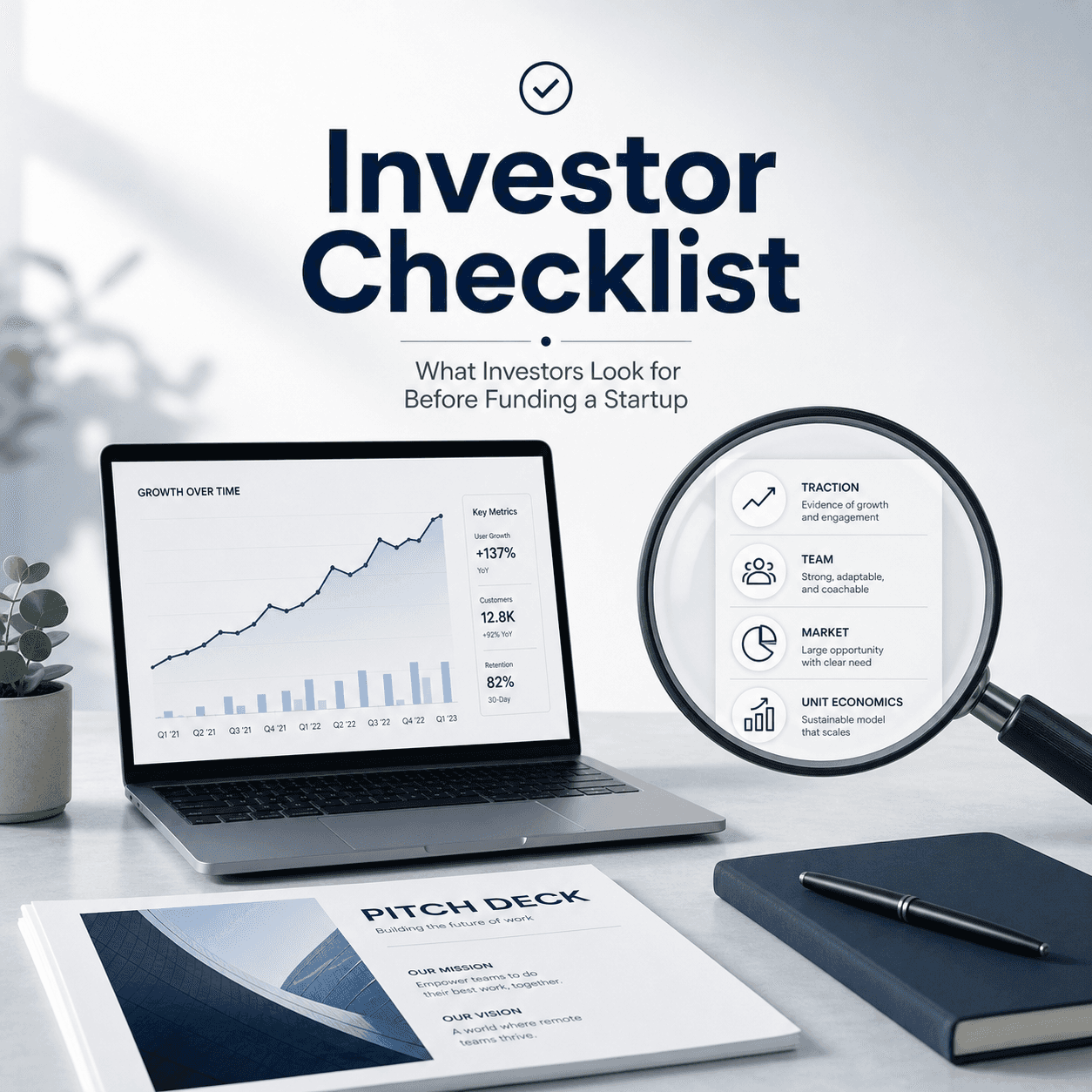
7. Traction, yes. But the right kind of traction
Traction is one of those words that gets abused. Founders will call anything traction.
Investors are looking for traction that suggests repeatability and pull. Not just a one off spike.
Some traction signals investors take seriously:
- Retention that holds. Cohorts that do not collapse after week two
- Usage frequency that matches the problem. Daily if it is core workflow, weekly if it is planning, etc
- Revenue quality. Paying customers who renew, not one time discounts
- Sales cycles that are understandable, not random
- Expansion revenue. Users buying more over time
- Organic growth. Word of mouth, referrals, inbound requests
Traction that can be misleading:
- Vanity metrics like impressions, downloads, signups with no activation
- A big logo that is actually a free pilot with no champion
- Revenue that is mostly services disguised as SaaS
- Growth driven entirely by paid ads with no retention
It is not that these are “bad.” It is that they do not prove what investors need proven.
To truly understand what makes a business defensible or attractive to investors, we can draw on economic theories such as those discussed in the New Palgrave Dictionary of Economics. These insights can provide a deeper understanding of the factors influencing business success and investor confidence.
8. A believable go to market plan
This is where a lot of pitches die.
Founders say: “We will use social media,” or “We will run ads,” or “We will do SEO.”
Investors hear: “We have not figured out distribution.”
A believable go to market plan answers:
- Who is the buyer?
- Who is the user?
- Where do they hang out?
- What triggers the purchase?
- What is the sales motion? Self serve, inside sales, enterprise?
- What is the pricing logic?
- What is the expected sales cycle?
And crucially: what is the first channel that works before you scale into the others?
If you say “partnerships” you will get pushed. Partnerships are great, but they are slow, political, and hard to count on early. If partnerships are your only plan, investors get cautious.
The best go to market plans sound like they came from real conversations. Because they did.
“I sold this at my last job. I know the decision maker. The buying process is typically 30 to 45 days. First we land with one clinic, then expand across the group.”
That is the kind of thing that feels grounded.
9. Unit economics direction (even if it is early)
At seed stage, investors do not expect perfect LTV and CAC math. But they do want to know you understand the machine you are building.
So they look for:
- Gross margins that make sense for the business model
- A path to profitable acquisition, not permanent paid growth addiction
- Pricing that is not purely random
- Customer payback period that is not insane
- Revenue that can scale without costs scaling linearly
If your product requires heavy manual onboarding, custom work, or ongoing support, that is not automatically a dealbreaker. But investors will ask: can this become scalable software, or is it a services business in disguise?
Sometimes the answer is: yes it is services right now, on purpose, to learn. That can be fine. But you need to say it clearly and show the plan to productize.
10. A thoughtful understanding of competition
Saying “we have no competitors” is one of the fastest ways to lose credibility.
If there is no competition, either:
- the market does not exist, or
- you have not looked hard enough, or
- the real competitor is “doing nothing” and that is still competition
Investors want to see that you understand the landscape and your positioning.
Good competitive analysis includes:
- direct competitors (same solution)
- indirect competitors (different solution, same outcome)
- internal tools or manual workflows (spreadsheets, email, humans)
- incumbent platforms that could build your feature
And then the important part: why you win.
Not “we are better.” But how you win.
“Incumbents target enterprise, we target mid market with faster onboarding.” “Competitors are horizontal, we are vertical with deeper workflows.” “We integrate into the system of record, they sit on top and get cut out.”
Specific. Simple. Memorable.
11. Risk awareness, without being negative
Investors are literally paid to think about risk. They will scan for it automatically.
Market risk. Technical risk. Regulatory risk. Team risk. Timing risk. Pricing risk. Distribution risk. Funding risk.
Founders who pretend there is no risk look naive. Founders who list 30 risks look overwhelmed.
The sweet spot is a founder who can say:
“Yes, this is the hard part. Here is how we are de risking it. Here is what we will learn in the next 90 days. Here is what would change our mind.”
That last part matters. Investors trust founders who can update their beliefs.
12. Momentum and speed of learning
Not just speed of shipping. Speed of learning.
Investors often ask questions like:
- “What did you learn from your last 10 customer calls?”
- “What changed in the product after you launched?”
- “What did you try that did not work?”
They are looking for a founder who runs tight loops.
Build. Ship. Measure. Talk to users. Adjust. Repeat.
A startup that is moving fast in the wrong direction is not impressive. A startup that is learning fast and correcting course is.
13. Storytelling that is clear, not dramatic
A pitch is a narrative. It has to make sense.
Investors look for clarity:
- What do you do?
- For whom?
- What is the outcome?
- Why now?
- Why you?
- Why will this be big?
- What do you need money for?
- What milestones will you hit with this round?
If your story is too complicated, investors worry your go to market will also be complicated. Confusion is expensive.
Also, a small thing: investors do not love exaggerated claims.
If you say “we will be a billion dollar company in three years,” it sounds like you are performing. Better to show the path.
“Here is the segment. Here is pricing. Here is adoption. Here is expansion. If this works, we can get to X in revenue.”
That feels adult.
14. Clean fundraising mechanics
This is boring, but it matters.
Investors look at how you run the raise:
- Do you know how much you are raising and why?
- Do you have a reasonable valuation or terms in mind?
- Do you have a data room ready? Metrics, cap table, financial model, customer references
- Do you respond quickly?
- Do you follow up cleanly?
- Are you honest about what you know and what you do not know?
Fundraising is often the first real “process” investors see you run. If it is chaotic, they wonder how you run sales, hiring, product.
And if you are weird about the cap table, or you have messy prior notes, or unclear ownership, that can slow down or kill deals. Investors hate surprises late in diligence.
15. What they look for in your “use of funds”
When an investor writes a check, they want to know what that money does.
Not “grow the team” in a vague way. More like:
- hire 1 senior engineer to ship X
- hire 1 sales lead to validate outbound
- spend Y on paid experiments to test CAC
- hit Z milestones: revenue, retention, new product line, enterprise readiness
Investors like funding rounds that buy clarity.
If your use of funds sounds like it buys time, they worry you will come back in 9 months with the same questions, just with less runway.
16. The gut check, the thing nobody admits
After all the metrics and slides, there is still a final filter.
Do I want to work with this founder for the next 7 to 10 years, through chaos, pivots, bad quarters, maybe lawsuits, maybe layoffs, definitely stress?
Investors pay attention to:
- coachability (not obedience, just openness)
- integrity
- consistency
- how you treat your cofounder and team
- whether you are grounded in reality
- whether you can sell without being slippery
This is why warm intros matter, and why references matter. People invest in people.
Even if the market is huge, investors hesitate to back founders who feel dishonest or unstable. It is not personal. It is risk math.
A simple way to self audit your startup before you pitch
If you want a quick checklist you can actually use, ask yourself:
- Can I explain the problem and buyer in one sentence?
- Do I have proof that real users care, even small proof?
- Do I know my first distribution channel and why it works?
- Do retention and usage match the seriousness of the problem?
- Can I explain why we win against the top 3 alternatives?
- Do I know the biggest risk and the next step to reduce it?
- Is my team obviously capable of building and selling this?
- Do I know what this round funds, specifically?
If you can answer those cleanly, you are already ahead of most decks investors see in a week.
Let’s wrap it up
Investors are not just buying your idea. They are buying your ability to turn a messy early product into something scalable, defensible, and valuable. They want a real problem, a big enough market, evidence that people care, and a team that can execute and keep learning fast.
If you take one thing from this, make it this: the goal of a pitch is not to sound impressive. It is to make the business feel inevitable. Not guaranteed. Just… inevitable if the team keeps pushing.
That is what gets funded.
FAQs (Frequently Asked Questions)
What do investors really look for when deciding to fund a startup?
Investors look beyond confidence and pitch decks; they assess a clear, specific problem that causes significant pain, the market size and entry strategy, evidence of real demand, founder market fit including deep customer understanding and resilience, and a team with the right skills appropriate for the startup’s stage.
Why is identifying a ‘painkiller’ problem more attractive to investors than a ‘vitamin’ problem?
Investors prefer funding solutions that address urgent and frequent pains (‘painkillers’) rather than nice-to-have improvements (‘vitamins’). A good problem is specific, happens often, affects someone willing and able to pay, and has poor existing alternatives. This ensures the startup solves a real need worth investing in.
How important is market size and entry strategy to investors?
Market size matters because venture returns depend on big outcomes. However, investors also want a sharp entry wedge—a focused initial customer segment with clear reasons for early adoption and accessible reach. A narrow starting point that logically expands demonstrates a viable growth plan rather than vague ambition.
What kind of evidence of demand do investors seek at various funding stages?
At pre-seed, investors look for waitlists, letters of intent (LOIs), pilots, or early revenue. Seed stage demands active users with retention and organic growth. Series A requires repeatable acquisition channels, strong retention cohorts, meaningful revenue growth, and clear unit economics. Real user engagement—even if inconvenient—signals genuine demand.
What does ‘founder market fit’ mean and why is it crucial?
‘Founder market fit’ refers to whether founders are uniquely positioned to solve their chosen problem. It involves deep customer understanding, industry experience or lived pain points, unfair advantages like relationships or credibility, ability to recruit key talent, and resilience to endure startup challenges. Investors favor founders with insight and grit over trendy ideas without roots.
How do investors evaluate the startup team during early funding rounds?
Investors want teams with critical skill coverage relevant to the product—technical founders for tech products, sales experts for go-to-market heavy offerings, credible researchers for science-based ventures. They observe team dynamics during pitches for cohesion and engagement. Overstaffing early can be negative; focus on quality and complementary skills matters most.