







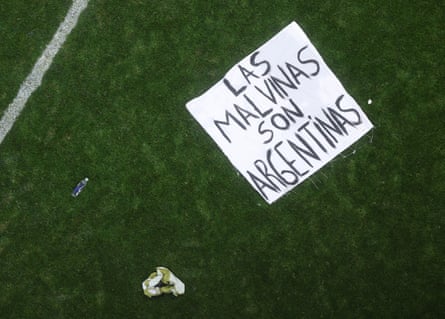



A political banner displayed after Argentina’s World Cup semifinal victory has reopened a decades-old sovereignty dispute and placed FIFA’s enforcement rules under scrutiny.
Argentina’s celebrations after reaching the 2026 World Cup final have become the subject of a diplomatic controversy.
Following Argentina’s 2-1 semifinal victory over England in Atlanta, several Argentine players were photographed holding a banner handed to them by supporters. The banner declared in Spanish that the Malvinas—known in Britain as the Falkland Islands—belong to Argentina.
The British government subsequently urged FIFA to investigate the display. FIFA prohibits political messaging inside stadiums and may discipline teams or national associations when players display political slogans during official matches and related on-field activities.
Why the islands remain disputed
The Falkland Islands are administered by Britain but claimed by Argentina, which calls them the Islas Malvinas.
The dispute led to war in 1982 after Argentina’s military government invaded the islands. Britain regained control following a conflict lasting approximately ten weeks.
Argentina has maintained its sovereignty claim ever since. Britain argues that the wishes of the islanders must be respected, and residents voted overwhelmingly to retain their political status as a British overseas territory in a 2013 referendum.
For many Argentines, the islands remain a powerful national symbol. In Britain, the issue is closely associated with the lives lost during the war and the principle of self-determination.
That history explains why a short message on a banner can produce an immediate diplomatic reaction.
What FIFA could do
FIFA has previously sanctioned national associations over political or provocative banners, symbols and chants. Possible consequences can include a warning, a fine or other disciplinary measures depending on the circumstances and whether officials determine that players or the association were responsible.
The central question is whether FIFA treats the post-match celebration as part of the official match environment and whether the players understood the banner’s content before displaying it.
The fact that supporters reportedly handed the banner to the players may become relevant, but it does not automatically remove responsibility. Governing bodies generally expect teams to control political displays made by players on the field.
Why the case matters beyond one banner
The dispute also presents a broader challenge for FIFA.
Football frequently intersects with identity, history and politics, particularly during international tournaments. FIFA attempts to separate political campaigning from competition, yet national teams inherently represent countries, flags and historical narratives.
Critics will therefore judge not only whether FIFA punishes Argentina, but whether its response is consistent with previous cases.
A severe punishment could be portrayed in Argentina as an attempt to silence a national position. A weak response could be criticized in Britain as selective enforcement of FIFA’s rules.
Whatever FIFA decides, the controversy is unlikely to disrupt Argentina’s preparation for the final against Spain. It has, however, ensured that one of football’s oldest geopolitical disputes will remain part of the conversation surrounding the tournament.