






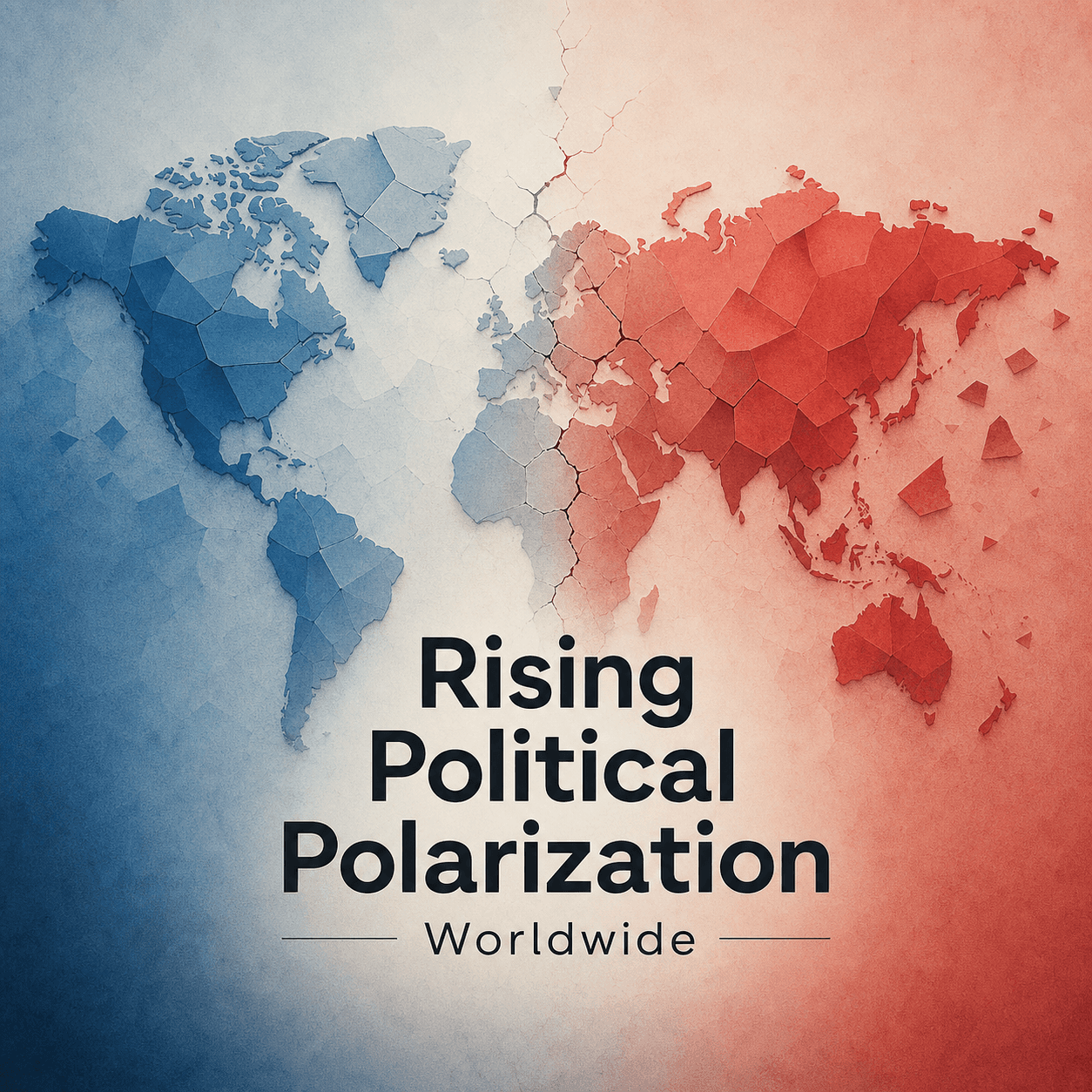
If it feels like politics is getting louder, meaner, and more “pick a side” everywhere… you are not imagining it.
This is happening in countries with two big parties and in countries with ten. In long established democracies and in newer ones. In places with high trust institutions and places where nobody trusts anything. Different cultures, different histories, and yet the same vibe keeps showing up.
People are sorting into camps. Families avoid certain topics. Everyday stuff like sports, movies, even public health turns into a political identity test. And the part that messes with your head is that a lot of people honestly believe the other side is not just wrong, but dangerous.
So why does polarization keep increasing worldwide?
It is not one thing. It is a stack of things, and they feed each other.
Polarization is not just disagreement anymore
Disagreement is normal. You can argue about tax rates or zoning rules and still think the other person is basically decent.
But in many places the conflict has shifted from “What policy works?” to “Who are you, really?” And once politics becomes identity, everything gets stickier.
This is the difference between:
- Issue polarization: people disagree on policy
- Affective polarization: people dislike and distrust the other side as people
Affective polarization is the scary one. Because it makes compromise feel like betrayal. It makes elections feel like existential threats. It makes “winning” more important than governing.
And it is spreading.
The causes of this shift are multifaceted and complex, involving various social, economic, and political factors that intertwine and exacerbate one another.
Social media did not invent division, but it industrialized it
Humans have always formed groups. We love teams. We love belonging. We also love gossip, outrage, and moral storytelling. Social media simply took these instincts and put them on a rocket.
A few things happen online that push polarization upward:
Algorithms reward emotion, not accuracy
Platforms optimize for attention. Attention is easiest to capture with content that triggers anger, fear, humiliation, and disgust. Calm nuance does not perform well. A thoughtful policy explainer loses to a 12 second clip that makes you furious.
So the feed becomes a pressure cooker.
And even if you personally try to follow balanced sources, the “most viral” content tends to be the most extreme version of whatever viewpoint you already lean toward.
Everyone gets their own reality stream
In many countries, people used to share a handful of mainstream news sources. They might interpret them differently, sure, but at least they were reacting to the same basic facts.
Now you can build a full information diet that never challenges you. Or worse, that constantly tells you the other side is lying and evil. Over time, two groups can live in the same city and feel like they are living in completely different countries.
Outrage spreads faster than correction
False claims and distorted narratives move quickly, especially when they give people a villain. Corrections are slower, less satisfying, and often arrive after the emotional damage is done.
Plus, when trust is already low, corrections can backfire. People treat them as propaganda. So the cycle continues.
Traditional media also plays a role, even when it tries not to
It is tempting to blame everything on the internet, but older media structures matter too.
In some places, news outlets are openly partisan. In others, they are formally neutral but compete in a harsh attention market, which pushes them toward conflict framing. Politics becomes a sport. Coverage focuses on scandals, gaffes, and “who is up, who is down” because it is easier to package than boring governance.
Also, many media systems have consolidated. Fewer owners, fewer local outlets, less ground level reporting. When local news dies, national political identity often fills the gap. People start relating to politics through big symbolic battles instead of practical community issues.
And that tends to polarize.
Economic stress makes people more receptive to zero sum politics
A lot of polarization is emotional, but emotions usually attach to real pressures.
Across many countries, people feel like the future is less secure than the past. Even where GDP is growing, the lived experience can feel worse: high housing costs, unstable work, debt, expensive childcare, weak safety nets, corruption, and the sense that powerful groups always get rescued first.
When people feel squeezed, politics becomes more about blame and protection.
Here is the uncomfortable part. Economic pain does not automatically produce polarization. It can also produce solidarity. But it becomes polarizing when:
- institutions look captured or unfair
- inequality is visible and humiliating
- upward mobility feels blocked
- people believe the system is rigged
Then “the other side” becomes the face of the rigging. Elites, immigrants, the urban professional class, rural conservatives, the old, the young. The target changes by country, but the structure is similar.
And once politics becomes a fight over who gets dignity and security, it is hard to keep it polite.
Identity and culture issues are more central than they used to be
In many democracies, class based politics has weakened. Labor unions shrank. Big workplace identities faded. Parties that used to organize around economics increasingly organize around culture.
At the same time, societies have changed quickly: migration, urbanization, changing gender norms, religious decline in some places and religious revival in others, new visibility for minority groups, and globalization bringing different lifestyles into contact.
These changes are real. For some people they feel liberating. For others they feel like a loss of status, tradition, or control. And politics becomes the arena where that fear and resentment gets processed.
Culture issues are also moral issues, which makes them hard to compromise on. You can split the difference on a tax bracket. You cannot easily split the difference on whether something is sacred or sinful, whether something is oppression or freedom.
So conflict intensifies.
Political parties have incentives to polarize
It sounds cynical, but polarization often works. Especially for winning elections, raising money, and keeping coalitions together.
Negative partisanship is a powerful fuel
Many voters are motivated less by love for their side and more by hatred or fear of the other side. This phenomenon known as negative partisanship, drives parties to exploit these emotions for their benefit.
Campaigns emphasize threats. Media allies repeat them. Activists amplify them. And even if the threat is exaggerated, the strategy can be effective.
Primaries and internal selection reward the intense
In systems where candidates are chosen by party members or primary voters, the most engaged people have outsized influence. The most engaged are often the most ideological. So parties drift toward their bases, not toward the center.
Even in countries without primaries, candidate selection can be controlled by activists, factions, or donor networks. Again, not exactly a recipe for moderation.
Governing failure creates more polarization
When governments fail to deliver results, trust declines. When trust declines, people assume bad faith. When everyone assumes bad faith, compromise becomes politically dangerous. Which makes governing even harder.
It is a nasty loop.
Institutions are under stress and in some places they are weaker than people realize
Polarization gets worse when institutions cannot absorb conflict.
Things like:
- courts viewed as partisan
- electoral systems seen as unfair
- corruption scandals that go unpunished
- police and military perceived as aligned with one side
- legislatures that cannot pass basic laws
- bureaucracies that are politicized or incompetent
When people stop believing institutions are neutral referees, politics turns into a street fight. Every election becomes a battle to control the state, because the state is no longer trusted to treat opponents fairly.
This dynamic is visible in many regions, not only in one country or one continent.
Geography is sorting people into like minded bubbles
This one is sneaky. People move. Not always for politics, but politics follows.
Urban areas often become more progressive, more diverse, more connected to global markets. Rural and ex industrial areas may feel ignored, older, and more tied to local tradition. Suburbs can swing, but even there you can get micro sorting.
Once communities become politically homogeneous, a few things happen:
- people have fewer cross cutting friendships
- stereotypes about the other side go unchallenged
- local leaders and media reinforce one worldview
- political talk becomes more extreme without social cost
Then when groups meet nationally, they feel like strangers.
And strangers are easier to hate.
International pressures amplify domestic conflict
Polarization is “worldwide” partly because countries are not isolated. Crises spill over.
Energy shocks, wars, refugee flows, supply chain disruptions, pandemics, climate disasters, and economic volatility all put stress on governments. When a crisis hits, leaders must make tradeoffs, and tradeoffs create enemies.
Also, foreign interference and transnational propaganda ecosystems are real. Some actors benefit from destabilizing other societies, or at least from making them distrustful and chaotic. Even without a conspiracy, global networks of influencers spread narratives across borders. A political style that works in one country gets copied elsewhere. The tactics travel fast.
So you get a kind of polarization globalization.
The pace of change is exhausting and politics becomes the outlet
A lot of people are tired. Not just financially, but cognitively.
The modern world asks individuals to process endless information, constant updates, shifting norms, and unstable expectations. That creates anxiety. Anxiety looks for stories that simplify.
Polarization offers simple stories:
- we are the good people
- they are the corrupt ones
- if we win, things will be fixed
- if they win, everything collapses
These stories feel emotionally relieving. Even if they are wrong, they give you a map.
And once you adopt the map, you defend it. Because without it, the world feels chaotic again.
What keeps it rising is that these factors reinforce each other
This is the main point, honestly. Polarization is not one cause. It is feedback loops.
Here is one common loop:
- Economic and cultural stress increases insecurity
- Politicians use identity conflict to mobilize support
- Media systems amplify conflict because it drives engagement
- Social platforms intensify outrage and isolate communities
- Trust in institutions declines
- People assume the worst about opponents
- Compromise becomes impossible
- Governance fails
- Insecurity rises again
Round and round.
Different countries enter the loop at different points. But once the loop starts, it is self sustaining.
So, is it hopeless?
No. But it is harder than “just be nicer” or “just get off Twitter.”
Polarization drops when people feel that:
- the rules are fair
- the economy is not a casino
- institutions punish corruption consistently
- leaders are rewarded for solving problems, not performing outrage
- communities have shared spaces and shared goals again
And some places have made progress through electoral reforms, civic initiatives, local journalism rebuilding, and real anti corruption enforcement. It is possible.
Still, the reason polarization continues to increase worldwide is that the incentives currently favor it. Attention markets favor it. Weak institutions cannot stop it. Fear based politics benefits from it. And a lot of ordinary people, feeling unheard, cling to it because it gives them clarity.
Not peace. But clarity.
And until more societies change those incentives and rebuild basic trust, the volume keeps going up.
FAQs (Frequently Asked Questions)
Why does political polarization seem to be increasing worldwide?
Political polarization is rising globally due to a complex stack of social, economic, and political factors that feed each other. This trend is evident in countries with varying numbers of political parties, different histories, and levels of institutional trust, leading to people sorting into opposing camps and treating politics as an identity test.
What is the difference between issue polarization and affective polarization?
Issue polarization refers to disagreements on policies or specific issues, where people may still view each other as decent individuals. Affective polarization, however, involves disliking and distrusting the opposing side as people, making compromise feel like betrayal and elections feel like existential threats. This emotional divide is more dangerous and is spreading globally.
How does social media contribute to increasing political polarization?
Social media amplifies human instincts for belonging, gossip, outrage, and moral storytelling by rewarding emotionally charged content over calm nuance. Algorithms prioritize anger and fear-inducing posts for attention, users can curate echo chambers with no challenge to their views, and false claims spread faster than corrections. This creates a pressure cooker effect that intensifies polarization.
What role do traditional media outlets play in political polarization?
Traditional media contributes to polarization even when trying not to by competing in harsh attention markets that favor conflict framing and scandal coverage over governance details. Consolidation of media ownership reduces local reporting, causing national political identity battles to fill the gap. Partisan outlets or neutral ones pressured by market forces both tend to polarize audiences.
How do economic stress and perceived inequality influence political polarization?
Economic stress makes people more receptive to zero-sum politics when institutions appear unfair or captured, inequality feels visible and humiliating, upward mobility seems blocked, and the system is believed rigged. Under these conditions, politics becomes about blame and protection, with ‘the other side’ seen as responsible for rigging the system, deepening emotional divides.
Why are identity and cultural issues becoming more central in modern political polarization?
As class-based politics weaken due to shrinking labor unions and fading workplace identities, parties increasingly organize around cultural issues. Rapid societal changes like migration, urbanization, evolving gender norms, religious shifts, minority visibility, and globalization bring diverse lifestyles into contact. These dynamics elevate identity and culture as focal points in political divides.