





I still remember when “politics online” mostly meant a long Facebook status, a couple angry comments, and that one uncle who posted conspiracy links at 2 a.m.
Now it’s… different. Faster. Louder. More creative, sometimes more informed, sometimes completely detached from reality. And it’s not just social media anymore. It’s YouTube explainers, TikTok clips, podcasts, Twitch streams, private group chats, subreddit threads, WhatsApp forwards, “community notes”, AI generated images, and those little recommendation widgets that quietly decide what you see next.
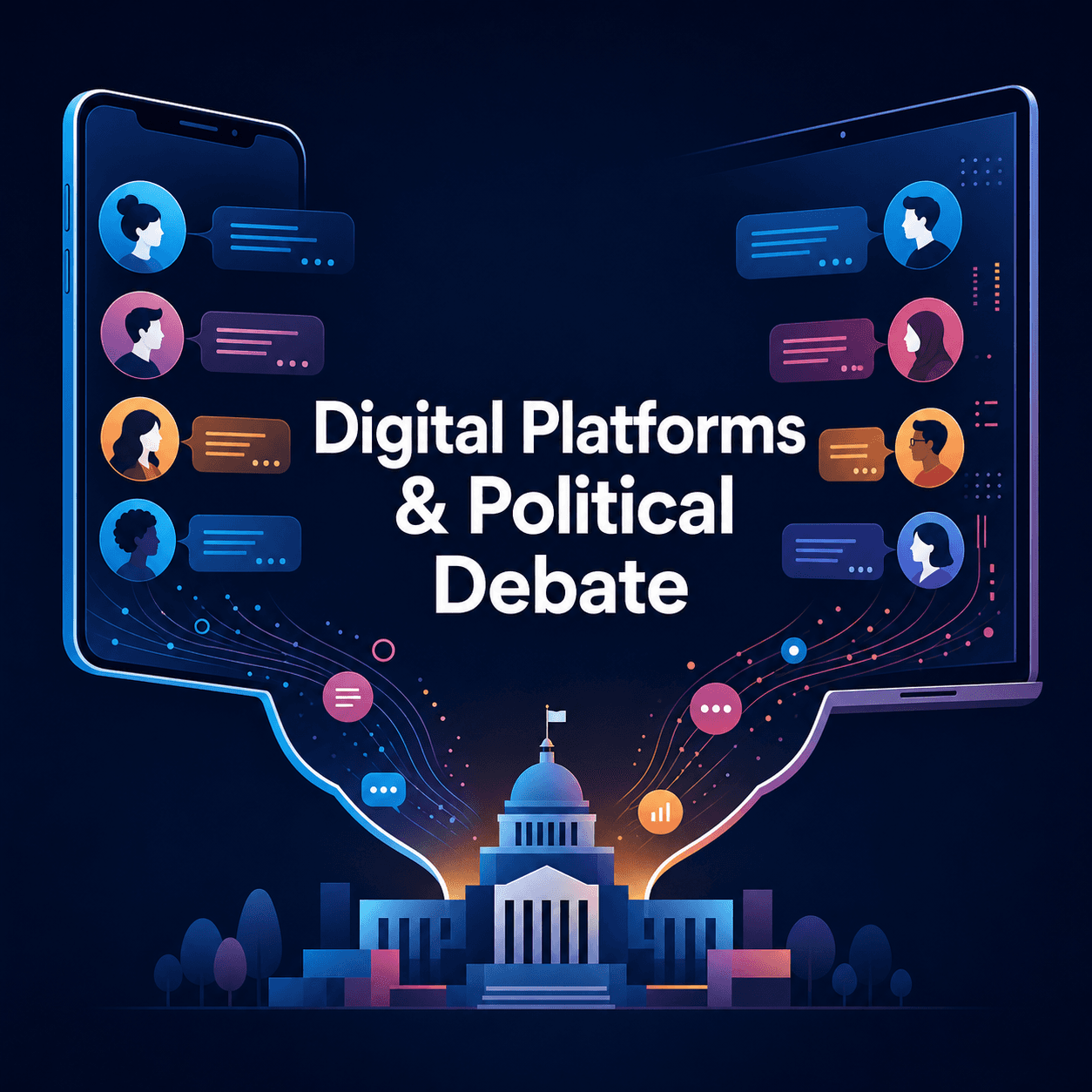
Digital platforms did not just move political discussion onto the internet. They changed the shape of the discussion itself. What people argue about, how they argue, who gets heard, what feels true, what feels urgent. Even what counts as “political” in the first place.
Let’s get into what’s actually happening.
The biggest shift is not what people believe. It’s how they arrive there.
In a pre platform world, a lot of political opinion was formed through slower channels. Newspapers. TV. Radio. Conversations at work or home. You might still be misinformed, sure. But the pipeline was narrower.
Platforms widened the pipeline and then strapped a rocket to it.
Now people arrive at political beliefs through:
- a viral clip with no context
- an influencer reaction video
- a meme that lands emotionally even if it is factually wrong
- an algorithmic feed that repeats the same theme until it feels obvious
- a comment section “debate” where the snarkiest line wins
And what’s weird is that you can be a very reasonable person and still get pulled into this. Because the mechanism is not about intelligence. It’s about exposure. Repetition. Social belonging. That little hit of certainty when a post makes you feel like you finally see the “real story”.
Platforms don’t just host opinions. They shape the path people take to get to them.
Algorithms reward engagement, not accuracy
This is the part everyone kind of knows, but it matters so much it’s worth repeating in plain language.
Most major platforms optimize for engagement. That means content that triggers:
- anger
- fear
- disgust
- tribal pride
- humiliation of the “other side”
- outrage curiosity, like “wait what did they just say?”
That does not mean every platform is intentionally trying to radicalize people. It’s simpler and more boring than that. The system learns what keeps you scrolling and then serves more of it. If outrage keeps you on the app, outrage gets promoted.
So political content becomes more performative over time.
The calm policy breakdown often loses to the punchy clip. The careful nuance loses to the confident hot take. The “I’m not sure” loses to “it’s obvious and anyone who disagrees is lying”.
And yeah, sometimes the accurate thing is also engaging. But accuracy is not the selection pressure. Engagement is.
Short form content changes political language
TikTok, Reels, Shorts. Even X posts and screenshot culture. All of it compresses language.
When you only have 30 seconds, or one caption, you don’t explain policy tradeoffs. You don’t build context. You don’t show uncertainty. You go for impact.
That impacts political discussions in a few ways:
- Politics becomes slogan shaped.
Ideas get turned into taglines. The taglines travel farther than the ideas. - It favors confident simplification.
Complex issues get flattened. Immigration, climate, healthcare, policing, war. Stuff that takes hours to understand becomes a 12 second clip. - It increases the value of “owning” someone.
If the goal is to be shareable, conflict becomes content. You want the moment. The clapback. The dunk.
This doesn’t mean short form is always bad. Sometimes it introduces people to issues they’d never look up otherwise. But it does mean the dominant style of political speech shifts toward punchy, emotional, and easily remixable.
Interestingly, this trend isn’t exclusive to social media platforms that prioritize engagement over accuracy; it’s also evident in traditional media formats such as news articles. These articles often favor brevity and sensationalism to attract readers, further influencing public discourse and perception of political issues.
And once that becomes normal, even long form discussions start to mimic it. People argue in soundbites even when they have time.
Platforms blur the line between entertainment and politics
A lot of political discussion now happens inside entertainment ecosystems.
A streamer reacts to a debate. A comedian riffs on a news story. A lifestyle influencer posts about a controversial law. A gaming community turns into a political identity group during an election cycle.
This can be good. It can also be messy.
On the good side, it lowers the barrier to entry. People who would never watch a formal news segment might learn something through a creator they trust.
On the messy side, it means political issues get packaged like content. And content has incentives.
Creators are under pressure to:
- post constantly
- have a take quickly
- escalate tone to stand out
- keep an audience emotionally invested
That can pull discussions toward drama. Toward certainty. Toward “my side versus your side”. Because that keeps people watching.
Sometimes it turns serious issues into fandom wars. Like politics becomes sports, with loyalty tests and rivalries and highlight reels.
The rise of micro publics and fragmented realities
One of the strangest effects of digital platforms is that we are not all living in the same political conversation anymore.
We are living in micro publics.
Your feed is not my feed. Your YouTube recommendations are not mine. The political stories circulating in one community might never reach another. Or they reach it filtered through mockery.
So you get:
- entirely different sets of “facts”
- different villains
- different priorities
- different interpretations of the same event
And then people meet in the comments or on X and genuinely cannot understand how the other person sees the world that way.
They assume bad faith. Because from inside their micro public, the conclusion feels obvious.
This fragmentation is one reason political discussions feel more exhausting now. You’re not just debating opinions. You’re often debating the underlying reality.
Virality rewards the extreme and punishes the average person
Another subtle thing. Platforms give disproportionate attention to extreme content, because it’s more shareable.
That doesn’t mean most people are extreme. It means the extreme voices travel further.
So if you’re a normal person with a mixed view, or you feel torn, or you want to ask a genuine question, you might not post at all. Or you post and get attacked from both sides.
This changes the visible conversation. It makes it look like everyone is polarized, because the moderate or uncertain voices are quieter.
Also, dogpiling is real. Public shaming dynamics, quote tweets, stitched videos mocking someone’s face. A lot of people learn that political speech online comes with social risk.
So they retreat into private chats. Or they perform whatever gets applause from their in group. Which leads to more polarization.
Platforms amplify identity based politics, even when the issue is not identity
To be clear, identity has always mattered in politics. But platforms intensify it.
Why? Because identity is sticky. It’s emotional. It’s social. And it drives engagement.
Instead of discussing a policy as a policy, discussions often become:
- what kind of person supports this
- what kind of person opposes this
- what group is being harmed
- what group is being mocked
- who is allowed to speak
- who is “one of us”
Sometimes that’s valid and necessary. Often it’s the whole point.
But it also means political disagreements feel like personal attacks. If your political stance is tied to your identity and your social circle, changing your mind becomes expensive. It can feel like betrayal.
So discussions harden.
People don’t just argue. They defend their belonging.
Misinformation spreads differently now. It’s not always “fake news”, it’s vibes.
Classic misinformation is a fabricated story. A fake headline. A doctored image.
But a lot of modern political misinformation is more subtle. It’s vibe based.
You see:
- a real clip with missing context
- a graph with no source
- a “just asking questions” thread
- a montage that implies a pattern that may not exist
- an AI generated image that feels plausible enough to pass
And then it spreads because it fits a narrative that people already feel.
This is the hard part. Fact checking is slow. Virality is instant. And even when something is corrected, the emotional impression remains.
Plus, corrections don’t travel as far. They are not as fun to share.
Also, some communities have learned to preempt correction. They treat mainstream debunks as proof of a cover up. So the misinformation becomes immune to refutation, because the refutation is part of the story.
The comment section is not a town hall, it’s a performance space
People still talk about “public discourse” online as if it’s a group of citizens rationally debating.
Sometimes it is. Often it’s not.
In comment sections, people are not just talking to the other person. They are talking to the audience. They want likes. They want ratio. They want approval from their side. They want to look strong.
So even when someone could concede a point, they won’t. Because it looks weak in public.
And platforms encourage this. They literally score the conversation with likes, shares, reposts, top comments.
It’s like trying to have a calm discussion while a crowd yells points at you. You start playing to the crowd. Most people would.
Private conversations still matter, but public political discussion online is often closer to theater than deliberation.
This phenomenon has been acknowledged by influential figures such as Barack Obama who discussed the complexities of modern political discourse in his conversation with Brian Tyler Cohen.
There are real positives too, and they’re not small
If this all sounds grim, it can be. But it’s not the whole story.
Digital platforms have also:
- expanded access to political information for people who never had it
- made it easier to organize, fundraise, and mobilize quickly
- given marginalized groups a way to speak directly, bypassing gatekeepers
- exposed corruption and abuse through citizen video and documentation
- created new educators, like creators who explain policy in plain language
A teenager can learn civic basics through a creator they trust. A local issue can go viral and get attention that traditional media ignored. A community can coordinate disaster relief faster than any institution.
So it’s not “internet bad”. It’s more like. The internet is a multiplier. It multiplies the best and the worst.
Politics becomes always on, and that changes people
One more thing that doesn’t get enough attention.
Platforms make politics continuous.
Even if you try not to engage, political content slips into your feed. A news clip. A meme. A quote. A scandal. Someone saying “if you don’t post about this you’re complicit”.
This creates political fatigue. People feel overwhelmed, guilty, pressured, numb, angry. And tired people are easier to manipulate.
When your nervous system is fried, you’re more likely to fall for simple stories. Good versus evil. One villain behind everything. One solution that fixes it all. One group to blame.
So political discussions become more emotional, less patient. Less curious.
And it becomes harder to do the slow boring work of democracy. Local meetings. Reading policy proposals. Showing up consistently. Those things don’t go viral. But they matter.
So what do we do with this?
Digital platforms are not going away. Political discussion will keep happening online. The question is how to participate without getting dragged into the worst incentives.
A few practical shifts help, even if they sound basic:
- Slow down before sharing. Especially if it makes you instantly furious.
- Follow people who disagree but argue honestly, not just provocateurs.
- Prefer primary sources when possible, full speeches, full bills summaries, full context.
- Move important conversations to smaller spaces when you can, group chats, calls, in person.
- Treat “virality” as a warning label, not a credibility signal.
And maybe the biggest one. Don’t confuse posting with doing. Posting can matter, but it’s not the same as voting, volunteering, donating, attending meetings, supporting local journalism, or even just talking to neighbors without trying to win.
Wrap up
Digital platforms have reshaped political discussions by changing incentives, speeding up information flow, fragmenting audiences, and turning argument into content.
They amplify extremes, reward emotion, and make politics feel constant. At the same time, they also open doors, spread awareness, and give people new ways to organize and speak.
So the influence is not one thing. It’s a push and pull.
If you want a simple way to think about it, it’s this. Platforms don’t just reflect political culture anymore. They produce it. In real time. Every day. With every scroll.
FAQs (Frequently Asked Questions)
How has online political discussion evolved from the early days of social media?
Online political discussion has transformed from simple Facebook statuses and occasional comments to a complex ecosystem involving YouTube explainers, TikTok clips, podcasts, Twitch streams, private chats, subreddit threads, WhatsApp forwards, AI-generated images, and algorithm-driven recommendations. This shift has changed not just where discussions happen but how political topics are framed, debated, and perceived.
What is the biggest shift in how people form political beliefs in the digital age?
The biggest shift is not necessarily in what people believe but in how they arrive at those beliefs. Unlike the slower channels of newspapers, TV, and radio in the past, today’s political opinions often form through viral clips lacking context, influencer reactions, emotionally charged memes (even if factually incorrect), repetitive algorithmic feeds, and snarky comment section debates. Exposure, repetition, social belonging, and emotional hits drive belief formation more than intelligence or traditional information pipelines.
Why do digital platforms tend to promote politically engaging content over accurate content?
Most major digital platforms optimize for engagement metrics like clicks and time spent rather than factual accuracy. Content that triggers emotions such as anger, fear, outrage curiosity, tribal pride, or humiliation of opposing views tends to keep users scrolling longer. As a result, platforms amplify performative political content—punchy clips and confident hot takes—while nuanced or calm policy discussions often get overshadowed.
How does short-form content affect political language and discourse?
Short-form formats like TikTok videos or brief social media posts compress complex political ideas into slogans or taglines that travel farther than detailed explanations. This favors confident simplifications over nuance and increases the emphasis on conflict moments like clapbacks or dunks to maximize shareability. While short-form can introduce new audiences to issues quickly, it also shifts dominant political speech toward punchy, emotional soundbites that flatten complex debates.
In what ways do digital platforms blur the lines between entertainment and politics?
Political discussions increasingly occur within entertainment ecosystems such as streamer reactions, comedian riffs on news stories, lifestyle influencers commenting on laws, or gaming communities adopting political identities during elections. While this lowers barriers for people to engage with politics via trusted creators, it also packages serious issues as content driven by incentives for constant posting, quick takes, escalating tone, and emotional investment—often leading to drama-centric “my side versus your side” dynamics resembling sports rivalries.
What is meant by ‘micro publics’ and fragmented realities in online political conversations?
‘Micro publics’ refer to the phenomenon where individuals inhabit separate digital spaces with distinct information flows—your social media feed differs from mine; your YouTube recommendations differ from mine—leading to fragmented realities. This means we are no longer sharing a common political conversation but multiple overlapping yet isolated discussions shaped by personalized algorithms and community memberships.