







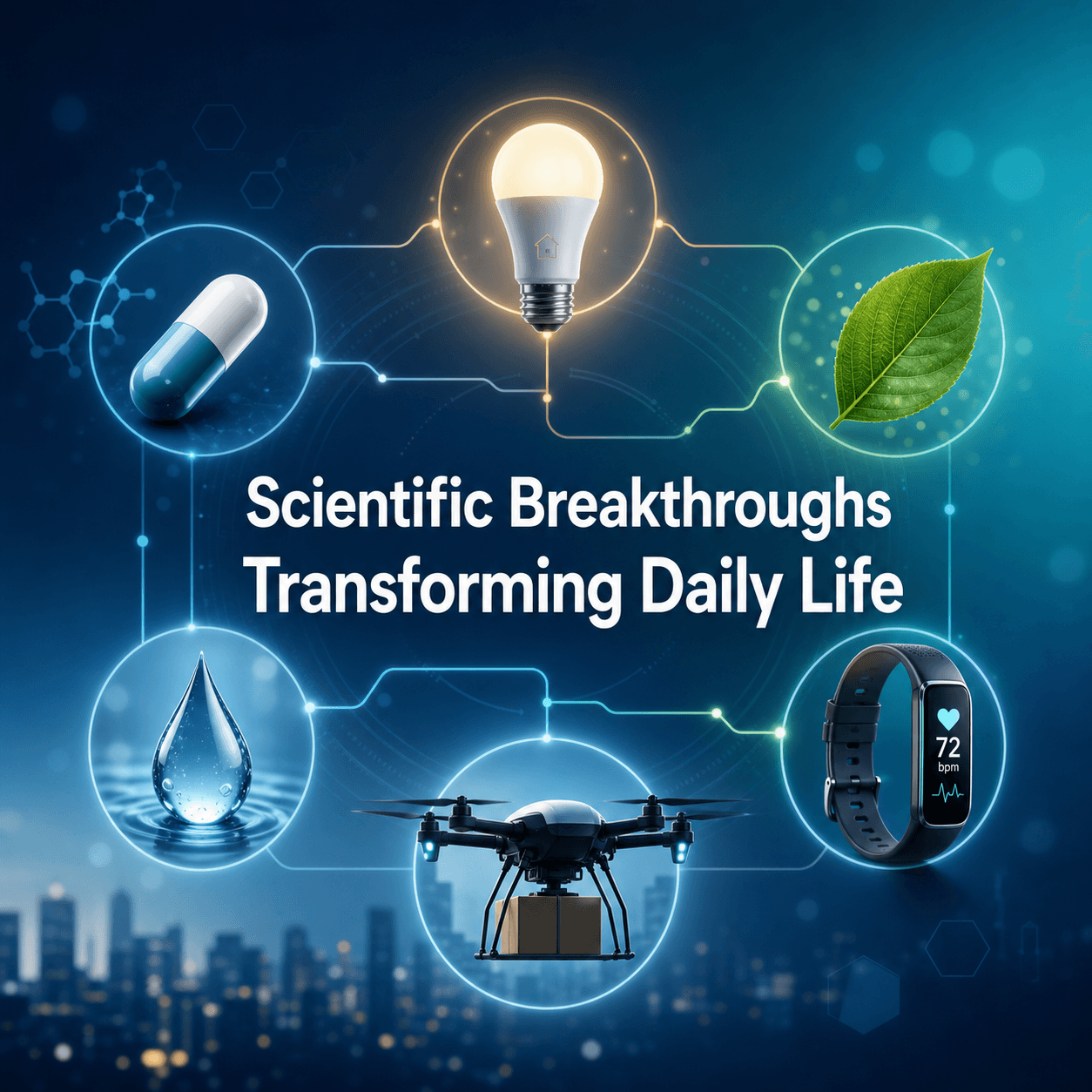
Most of the time, “scientific breakthroughs” sound like something that happens in a lab you will never visit, to solve a problem you do not have. And then one random Tuesday, that same thing shows up in your phone, your grocery store, or your doctor’s office, and you forget it was ever science in the first place.
That is the interesting part.
The biggest daily life changes usually come from boring sounding advances. Better batteries. Better sensors. Better ways to grow cells. Better math. Stuff that feels small until it stacks up and suddenly your life runs on it.
So here are a bunch of scientific developments that are quietly moving fast. Some are already here in early versions. Some are a few years out. A few are still in the messy, “this might work, might not” stage. But if even half of these land the way researchers think they can… daily life will look different.
Not sci fi different. Just… smoother. Less friction. More “why was this ever hard?”
1. Ultra cheap, always on health monitoring (that actually means something)
We already have watches that count steps and pretend they know your stress level. The real shift is happening with new biosensors and better signal processing. Sensors that can measure more than heart rate, and algorithms that can separate useful patterns from noise.
Think about:
- Continuous glucose monitoring moving beyond diabetes, so you can see how your body reacts to specific foods in real time.
- Wearables and patches that track hydration, electrolytes, temperature trends, and maybe even certain hormones through sweat or interstitial fluid.
- “Silent” early warnings for heart issues, sleep apnea, infections, atrial fibrillation, and other stuff that currently gets caught late.
The daily life transformation is not that you become obsessed with data. It is that you get nudged early. Before you feel awful. Before you need a serious intervention. That is the dream, anyway.
The hard part is accuracy and interpretation. A flood of false alarms would be a disaster. So a lot of the progress is not even the sensor itself. It is validation studies, calibration, and figuring out what to do with the information without making everyone anxious.
Still, you can see where this goes. Healthcare becomes more like maintenance, less like emergency repair.
2. Personalized medicine that is not just a buzzword anymore
For years, personalized medicine has meant, “we might adjust your dose.” Now it is starting to mean, “we understand your specific biology well enough to pick the right tool.”
A few drivers here:
- Cheaper genetic sequencing.
- Better models of protein folding and drug binding.
- More precise diagnostics, including liquid biopsies (blood tests that look for cancer DNA fragments and other signals).
In daily life terms, this could eventually reduce the trial and error loop so many people go through with medications. Antidepressants, blood pressure meds, autoimmune treatments, even pain management. If you have ever watched someone bounce between prescriptions for months, you know how big that is.
This also ties into pharmacogenomics, basically how your genes affect how you metabolize drugs. Some people process certain meds too fast, or too slowly, or with odd side effects. Knowing that upfront saves time and suffering.
Not everything will become custom made. But even a modest improvement in “we pick the right thing faster” is life changing for a lot of people.
3. mRNA and next gen vaccines that move at software speed
mRNA vaccines proved something important: we can design and manufacture certain vaccines fast, and update them when needed. That matters for pandemics, sure. But also for seasonal flu, RSV, and other infections that keep knocking people out every year.
The next wave includes:
- Self amplifying RNA, which aims to use smaller doses for the same effect.
- Better delivery systems, not just lipid nanoparticles, so the shots are more stable and easier to ship.
- Personalized cancer vaccines, where the vaccine targets mutations specific to a person’s tumor.
Daily life angle. Fewer sick days. Less fear around outbreaks. Better protection for older adults and kids. And maybe one day, fewer cancers that return after treatment because the immune system gets trained to hunt leftovers.
This is one of those areas where progress feels sudden. Like nothing happens for a while and then, boom, a new standard.
4. CRISPR and gene editing moving from “possible” to “practical”
Gene editing is already being used in limited cases for serious diseases. The shift that could affect more people is when delivery improves, editing becomes more precise, and costs come down.
There are different approaches now too. Not just classic CRISPR cuts, but base editing and prime editing, which can make more targeted changes with fewer unintended effects.
What does that mean for everyday life?
At first, probably not “designer babies.” More like:
- One time treatments for inherited blood disorders.
- Gene therapies that reduce risk of certain blindness conditions.
- Potentially editing immune cells to fight cancers more effectively.
Then further out, you start thinking about chronic conditions. Could we reduce genetic risk factors? Could we “turn down” certain pathways that drive high cholesterol or inflammation? The ethical and safety questions are huge. But the science is not slowing down.
Even if only a slice of this becomes common, it changes the relationship people have with lifelong disease.
5. AI powered discovery of new materials
This one is sneaky. Because it sounds abstract. “Materials science.” But materials are basically the hidden layer of modern life. The stuff your phone, car, home, and power grid are made of.
When researchers use AI to search for new battery chemistries, new catalysts, new alloys, new polymers. It can shorten the time from idea to usable material.
Here is what that could unlock:
- Batteries that charge faster and last longer.
- Cheaper solar panels and more efficient ones.
- Better insulation materials that cut heating and cooling costs.
- Stronger, lighter building materials.
- More recyclable plastics, or alternatives that do not linger forever.
You will not see “AI materials discovery” on a product label. You will just notice your devices last longer, your energy bill drops, and certain things stop breaking so easily.
6. Solid state batteries and beyond lithium ion
Lithium ion batteries are amazing, but also… moody. They degrade, they can overheat, they rely on supply chains that are not always stable.
Solid state batteries promise higher energy density and improved safety by replacing the liquid electrolyte with a solid one. There are also other approaches being explored, sodium ion batteries for example, which could be cheaper and easier to scale in some contexts.
If this develops the way optimists hope, daily life changes could include:
- Electric cars that charge faster and go farther.
- Phones and laptops that do not feel “tired” after two years.
- Home batteries that make solar power more practical.
- Less fear of battery fires in certain devices.
This is not a guaranteed win. Solid state is hard to manufacture at scale. But it is one of the most important “boring” technologies because everything electrified depends on energy storage.
7. Lab grown meat, precision fermentation, and a different food system
Food science is starting to split into two tracks.
One track is cultivated meat, growing animal cells in bioreactors. The other is precision fermentation, using microbes to produce specific proteins and fats, which can be used to make dairy alternatives, egg proteins, and other ingredients with less land and water.
Daily life effects, if this scales:
- More stable food prices, less tied to droughts and feed costs.
- New kinds of protein options that taste closer to the originals.
- Fewer antibiotics in the food chain.
- Reduced environmental pressure from livestock farming.
There is still a big “will people actually buy it” question. Also regulation, cost, and energy use. But the progress is real. And even if you never eat cultivated steak, precision fermentation could quietly show up in your cheeses, sauces, protein bars, and baking ingredients.
8. Water tech that makes clean water easier and cheaper
Water is going to be one of the main stress points of this century. Not everywhere, but in enough places that it will affect prices, migration, and politics. Which means the science of purification, desalination, and leak detection matters a lot.
Some developments worth watching:
- Better membranes for desalination and filtration, including graphene based research and advanced polymer membranes.
- Low energy purification methods.
- Sensors that detect contaminants fast, even at low concentrations.
- Smarter infrastructure monitoring that finds leaks before half the city’s water disappears into the ground.
Daily life version is simple. Safer drinking water. Fewer boil notices. Less bottled water. More reliable water supply in drought areas. And hopefully lower costs over time.
9. Carbon capture and “carbon to useful stuff”
Carbon capture has a reputation problem. And honestly, it has earned some of that skepticism. It has been used as a talking point more than a real tool in many places.
But there is legitimate research pushing forward on capturing CO2 from industrial sources and sometimes directly from air, then turning it into fuels, building materials, or chemicals.
One exciting development in this field is the potential for concrete to not only serve as a building material but also store CO2.
The daily life impact is indirect, but big. If we can reduce emissions without making everything unaffordable, that matters. If captured carbon becomes an input for products like concrete, that could create incentives that actually work in markets.
You might see:
- Concrete that stores CO2.
- Synthetic fuels for aviation.
- More low carbon manufacturing processes.
This is one of those areas where the tech is only half the story. Policy and economics decide whether it spreads.
10. Quantum sensing and ridiculously precise measurement
Quantum computing gets all the headlines, but quantum sensing might hit daily life sooner.
Quantum sensors can, in theory, measure time, gravity, magnetic fields, and motion with extreme precision. This can improve navigation, imaging, and detection.
Practical possibilities:
- Better medical imaging, potentially earlier detection with less invasive methods.
- Navigation that does not rely entirely on GPS, useful for ships, planes, and even infrastructure.
- More sensitive detection of underground structures, helpful for construction and resource mapping.
This one is not as “consumer visible” at first. But it can reshape industries that affect you, like healthcare and transportation.
11. Robots that are finally useful outside factories
We have had industrial robots for a long time. What is changing now is a mix of cheaper sensors, better batteries, better computer vision, and more capable control models. Robots are getting less fragile and less “only works in perfect conditions.”
Daily life transformations might look like:
- Warehouse automation that speeds deliveries and reduces costs.
- Elder care robots that assist with lifting, monitoring, basic chores.
- Household robots that do more than vacuum, like simple tidying, fetching, or assisting people with mobility challenges.
- Safer construction robotics for repetitive or dangerous tasks.
Not every home will have a humanoid robot. Probably not. But robot labor will show up around you, and it will influence the price and availability of services.
12. Brain computer interfaces and neurotechnology (carefully, slowly)
This category gets weird fast, so let us keep it grounded.
Neurotechnology is advancing in two main directions. Non invasive devices that read brain signals through the scalp, and implanted devices that can read and stimulate with higher precision.
The near term, realistic daily life changes are mostly medical:
- Better prosthetics control for people with limb loss.
- Treatments for certain kinds of paralysis, restoring some communication or movement.
- More effective therapies for chronic pain or neurological conditions, through targeted stimulation.
The consumer side, like controlling your phone with your mind, is the flashy part. But the meaningful part is quality of life improvements for people dealing with serious limitations.
And yes, privacy concerns are real. Brain data should not become just another “accept cookies” situation. That conversation needs to happen early, not after the tech spreads.
What this all adds up to
A lot of these developments point to the same direction. Life gets more preventive, more efficient, more tailored.
Not perfect. Not utopian. But more manageable.
You wake up, your wearable notices something is off before you do. Your doctor has more precise tools and fewer guesses. Food gets produced with fewer constraints. Energy storage improves so electric options become the default. Water gets safer. Materials get better. Diseases that used to be lifelong become treatable in a one and done way, at least for some people.
And there is a quieter shift too. Science is getting faster because tools are improving. Automation, AI, high throughput experiments, shared datasets. The pace itself might be the biggest transformation.
Some of this will disappoint. Some of it will get hyped too early. That is how it goes.
But if you are looking for a practical way to think about the future, it is not flying cars. It is health, energy, food, and materials. The boring foundations.
Once those change, everything sitting on top of them changes too.
FAQs (Frequently Asked Questions)
What are some examples of ultra cheap, always on health monitoring technologies?
Examples include continuous glucose monitoring beyond diabetes, wearables and patches that track hydration, electrolytes, temperature trends, and certain hormones through sweat or interstitial fluid. These devices also provide silent early warnings for heart issues, sleep apnea, infections, and atrial fibrillation.
How is personalized medicine evolving beyond adjusting medication doses?
Personalized medicine now leverages cheaper genetic sequencing, better models of protein folding and drug binding, and precise diagnostics like liquid biopsies to select the right treatment tools based on an individual’s specific biology. This reduces trial and error in medications such as antidepressants and blood pressure meds by understanding how genes affect drug metabolism.
What advancements are being made in mRNA and next generation vaccines?
Advancements include self amplifying RNA that requires smaller doses, improved delivery systems beyond lipid nanoparticles for better stability and shipping, and personalized cancer vaccines targeting mutations specific to a person’s tumor. These developments promise fewer sick days, better outbreak protection, and improved cancer treatment outcomes.
How is CRISPR and gene editing becoming more practical for everyday health applications?
Gene editing is progressing with improved delivery methods, increased precision through base editing and prime editing techniques, and reduced costs. Practical applications include one-time treatments for inherited blood disorders, gene therapies to reduce blindness risk, and editing immune cells to fight cancer more effectively, potentially transforming lifelong disease management.
What role does AI play in discovering new materials?
AI accelerates the search for novel battery chemistries, catalysts, alloys, and other materials that form the foundation of modern technology like phones, cars, homes, and power grids. By efficiently identifying new materials with enhanced properties, AI-driven discovery supports smoother daily life experiences through better performance and sustainability.
How will these scientific breakthroughs change daily life in the near future?
These advances will make daily life smoother with less friction by enabling continuous health monitoring that provides early warnings before serious issues arise; personalized medicine that selects effective treatments faster; rapid vaccine development reducing illness; gene editing therapies addressing chronic conditions; and AI-discovered materials enhancing technology reliability. Together they shift healthcare from emergency repair to proactive maintenance.